
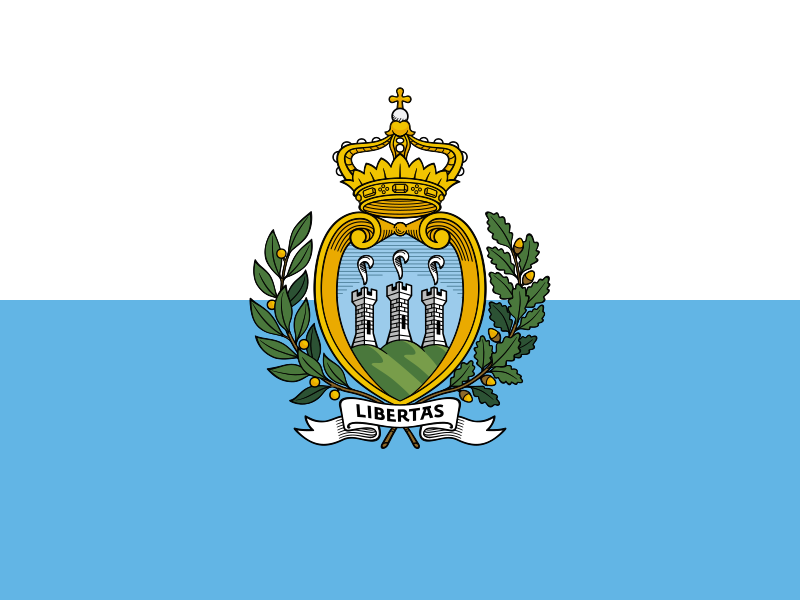
San Marino
Short description
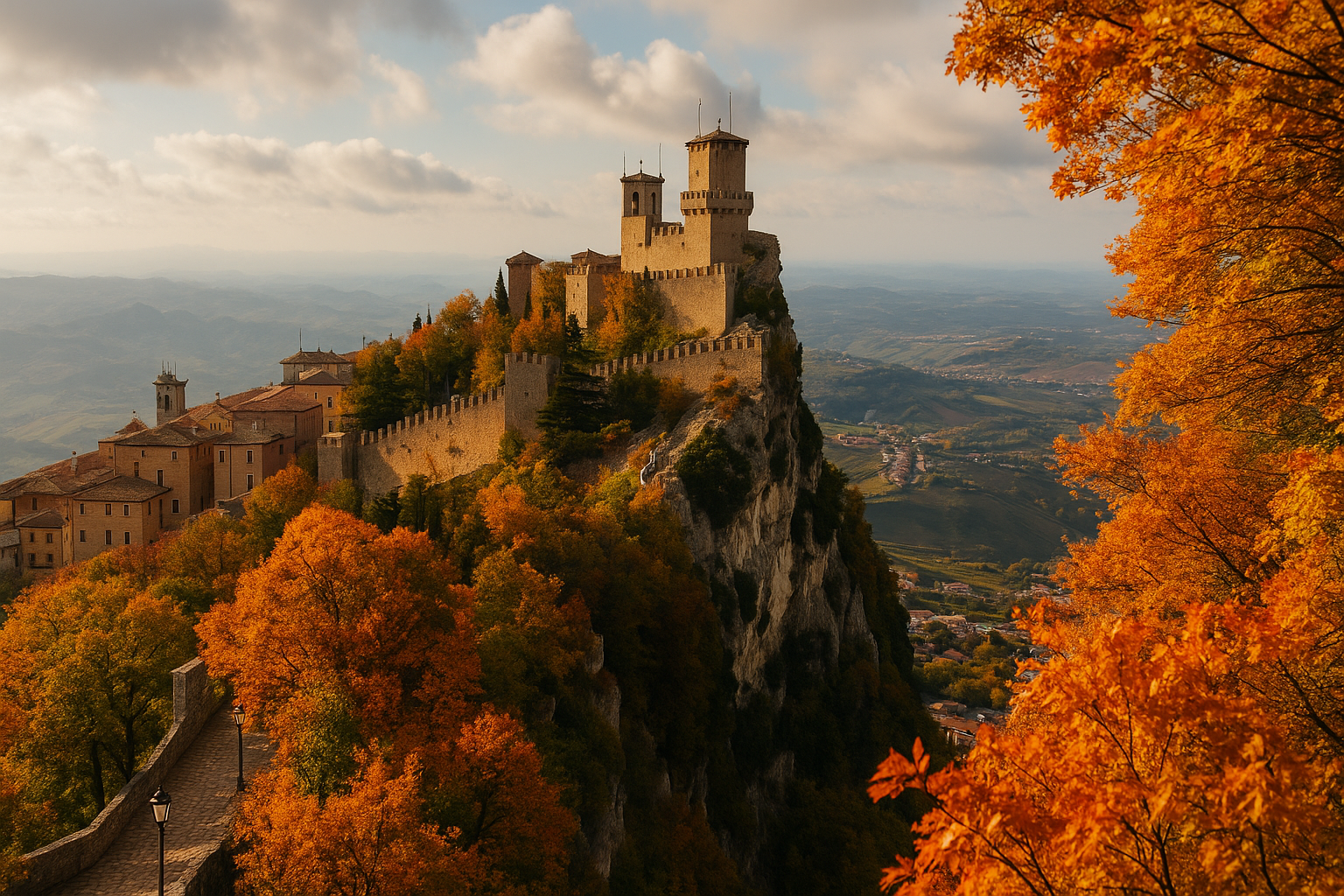
By September the road up Mount Titano sheds the summer coach crowds and the republic’s three medieval towers return to being landmarks for locals more than for guided groups.
How San Marino feels on the mountain
San Marino’s scale is the first thing you notice: the whole country can be crossed in an hour by car but it doesn’t behave like a compact city-state. Life concentrates on a narrow ridge and the terraced slopes below it, so days move on a steep axis — mornings might begin in a fog-filled valley and by mid-morning you are above the cloud with views across Emilia-Romagna and the Marche. Streets in the historic centre are mostly cobbles and sharp steps; that slows everything down, and even ordinary errands have a deliberate pace.
What autumn actually does here (September–November)
September keeps long, sunlit afternoons suitable for sitting at a café overlooking the ridge; October brings cooler air and the first damp that darkens the stone of the walls; by November the upper town often has low cloud and shorter opening hours. The tourist rhythm thins: many souvenir shops and outdoor vendors switch to shorter schedules, while a few family-run trattorie focus on heartier plates and local preserves rather than light summer fare.
Getting around and practical quirks
Distances are small but vertical: expect short drives and a lot of walking uphill. The cable car from Borgo Maggiore is the quickest lift to the historic centre; buses from Rimini and car parks at the foot of the mountain are where most visits begin. Italian is the everyday language and prices are in euros; cards work at most cafés and museums but smaller food stalls or mountain bars may prefer cash. Mobile signal is reliable in town but can drop on the forested slopes.
Food, daily life and common surprises
Meals follow an Italian rhythm but with local accents: sample Torta Tre Monti in a pasticceria or try cacciatat in a neighbourhood osteria — these are treats locals buy for festivals or colder evenings. Expect brief, friendly exchanges with shopkeepers in Italian, formal greetings with a light handshake and an abrupt change of pace when the Captains Regent change each April and October — official life filters down in small ceremonial ways even in autumn. Many visitors are surprised to find ordinary supermarkets, schoolyards and compact, lived-in neighbourhoods beyond the tourist lanes; San Marino is a functioning republic as much as it is a medieval skyline.
Quick 5
San Marino
San Marino
San Marino
San Marino
San Marino
Regions

Travel Requirements
What you need to enter San Marino, for the passport you hold.
Places of interest
Landscapes in San Marino
Travel Tips